
NAP8: Complications of Regional Anaesthesia
NAP8: Major complications of regional anaesthesia and perioperative nerve injury
NAP8 will investigate major complications of regional anaesthesia as well as perioperative spinal cord and peripheral nerve injury. We aim to assess the incidence, current practice and outcomes of these various complications.
The Royal College of Anaesthetists 8th National Audit Project (NAP8) will study complications of regional anaesthesia (peripheral nerve blocks and central neuraxial blockade) and local anaesthetic infiltration as well as perioperative spinal cord and peripheral nerve injury.
Around 1 in 4 anaesthetics involve peripheral regional or central neuraxial block in some form. The NAP8 case registry will focus on the major complications of peripheral regional and central neuraxial anaesthesia and analgesia. The team will also conduct an activity survey to collect information around neurological complications associated with general anaesthesia.
How will NAP8 work?
NAP8 will follow similar methods to previous NAPs, with three main components--the Baseline Surveys, Activity Survey, and Case Registry.
The Baseline Surveys have been open since December 2025 and will remain open until mid 2026. The Activity Survey will run for one week at each site between 8-21st June 2026 (specific dates for each site to be confirmed). The Case Registry will be open for 12 months and provisional launch date is 18th May 2026.
NAP8 Timeline

The NAP8 Activity Survey is running from 8th June to 29th June.
What is the activity survey?
The activity survey is a snapshot evaluation of nationwide anaesthetic activity and is a key part of the methodology of our National Audit Projects (NAP)s. The activity survey allows us to examine both how anaesthetic activity and our patient population has changed since previous NAPs, as well as to calculate an annual caseload denominator which is used to generate the incidence of the rare complications reported during the one-year NAP8 case registry phase. Without an accurate activity survey the project simply will not work.
The NAP8 Activity Survey will run over a three-week period from 8 – 29 June and each site has been allocated a one-week period to take part.
Your Local NAP8 Coordinator will provide you with more information and inform you which week your hospital will be participating.
How can you get involved?
Please look out for the QR code and survey links from your local co-ordinator and log any and all elective or emergency cases involving anaesthesia, sedation or monitored anaesthesia care performed or supervised by an anaesthetist or PAA. The activity survey is not just for regional anaesthesia and includes:
- All general anaesthesia, all regional anaesthesia, all sedation, all monitored anaesthesia care
- Cases in main theatres, day surgery, obstetrics, remote sites such as MRI, ECT
- All obstetric activity including labour analgesia
- Acute and chronic pain procedures, including recovery, intensive care unit, pain clinic
- Anaesthesia, sedation or regional anaesthesia in the emergency department only if performed or supervised by an anaesthetist/PAA
A full list of inclusion/exclusion criteria can be found here and some FAQs can be found here.
Please complete one survey entry for each case or episode of anaesthetic activity .
Please note that due to in-built logic questions in the survey may vary between cases depending on your anaesthetic technique. Please complete your answers carefully so that only the relevant questions appear.
As noted above your local co-ordinator will provide links and QR codes to access the survey – these are live links so please do not enter ‘test cases’. Please enter only true cases during your activity survey week.
A full list of questions is listed here for information.
We appreciate all submissions made during this period and your contributions will add incredibly helpful data to the project.
Local Coordinators
The success of NAP8 relies on the work of dedicated local co-ordinators and associate local co-ordinators in hospitals across the UK and Ireland.
List of Local Coordinators by Hospital
Please click here to see the list of UK and Irish local co-ordinators by hospital.
- Associate LCs will be added here shortly.
- If your hospital does not have a local co-ordinator and you would like to take on this role, please email nap@rcoa.ac.uk.
Local Coordinator Resources
Please click here to access our library of resources for local co-ordinators.
NAP8 Scope
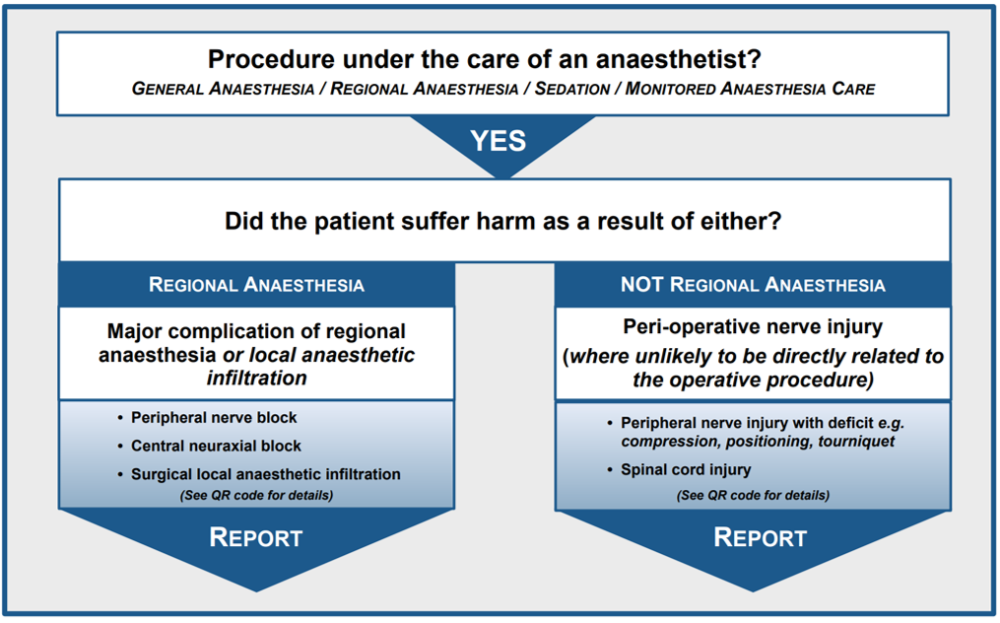
NAP8 Inclusion/Exclusion Criteria
The patient must be under the care of an anaesthetist or Physician Assistant in Anaesthesia (legally known as Anaesthesia Associates) at the time of the index procedure. All adults and children under the care of an anaesthetist or Physician Assistant in Anaesthesia (legally known as Anaesthesia Associates) involving general anaesthesia, regional anaesthesia or analgesia, local anaesthesia or monitored anaesthesia care (i.e., care by an anaesthetist but without administration of anaesthetic drugs) will be included. This includes cases occurring in the following clinical areas:
- All elective and emergency surgical procedures undertaken in main, trauma, day surgery and maternity (labour ward and obstetric theatres)
- All isolated sites (e.g. Electroconvulsive therapy)
- Interventional pain procedures in clinic or operating theatre
- All regional anaesthetic procedures in intensive care
- Any anaesthetic, sedation, or regional anaesthetic/analgesic procedure administered by an anaesthetist or Physician Assistant in Anaesthesia (legally known as Anaesthesia Associates) in the Emergency Medicine department (See below)
- Any regional anaesthetic/analgesic procedure carried out by an anaesthetist or Physician Assistant in Anaesthesia (legally known as Anaesthesia Associates) other than for the above circumstances including in intensive care or the wards e.g. rib fracture analgesia. Post-operative rescue nerve block should be treated as a separate entry if the NAP8 activity form for that patient has already been submitted.
The complication must be related to one or more of either a central neuraxial block (epidural, caudal, spinal or CSE), a peripheral nerve block or surgical local infiltration (including surgically placed local anaesthetic wound catheters)
- This includes attempted central neuraxial or peripheral nerve blocks that were abandoned for whatever reason
- This includes complications related to removal of any central neuraxial or peripheral nerve catheter
The complication must present during the case registry period
- If a complication presents during the case registry phase, but the original procedure occurred before the start of the case registry phase, please report.
Unless otherwise stated in the exclusion criteria for the specific complication (see Definitions of Regional anaesthesia/Local infiltration analgesia complications document below), please report all complications irrespective of the level of harm that occurred to the patient. The NAP8 team will classify level of harm using the information provided in the case registry report.
IF IN DOUBT, PLEASE REPORT.
Any complications arising in the following clinical scenarios fall outwith the scope of NAP8 and therefore should not be reported:
• Any procedures performed or complications presenting after the end of the case registry period, even if original procedure performed within the case registry phase.
• All procedures on critical care except for regional anaesthetic/analgesic procedures (see inclusion criteria).
• Intra- or inter-hospital transfers.
• Any blocks performed by someone who is not either an anaesthetist or a Physician Assistant in Anaesthesia (legally known as Anaesthesia Associates) or is not a healthcare professional performing the procedure under the overall supervision of an anaesthetist (e.g. blocks performed by emergency medicine physicians are excluded but blocks performed by pain nurses would still fall within the NAP8 scope and should be reported).
Lumbar punctures
All exclusions do not apply if the patient has already met, or later meets, the above specified NAP8 inclusion criteria. IF IN DOUBT, PLEASE REPORT.
The following complications are included in the NAP8 scope:
Complications resulting from regional anaesthesia (central neuraxial blocks/peripheral nerve blocks) or local anaesthetic infiltration:
Central neuraxial blocks (CNB) or peripheral nerve blocks (PNB) or local anaesthetic infiltration complications:
- Wrong route drug error
- Local anaesthetic systemic toxicity
- Pneumothorax
- Cardiac arrest due to PNB/CNB
- Infection at PNB/CNB site
- Anaphylaxis due to PNB/CNB
- Visceral or other organ injury
Central neuraxial blocks (CNB) complications only:
- High/total/complete spinal
- Respiratory failure
- Vertebral canal haematoma
- Vertebral canal abscess
- Infective meningitis
- Adhesive arachnoiditis
- Nerve injury after CNB
- Any other major CNB complication not listed above
Peripheral nerve blocks (PNB) or local anaesthetic infiltration complications only:
- Wrong site block
- Phrenic nerve palsy
- Haemorrhage
- Peripheral nerve injury due to PNB
- Any other major PNB complication not listed above
Complications NOT resulting from regional anaesthesia (general anaesthesia/sedation/monitored anaesthesia care):
- Peripheral nerve injury unrelated to direct surgical injury/CNB/PNB
- Spinal cord injury unrelated to direct surgical injury or surgical manipulation
For a full description and inclusion and exclusion criteria for each complication, please see the document below titled "NAP8 Definitions of Regional Anaesthesia/Local Infiltration Analgesia complications".
Click here to see the definitions of regional anaesthesia/local infiltration complications document
Click here to see the definitions of perioperative spinal cord or peripheral nerve injury following GA, sedation or MAC document
Meet the NAP8 team

Prof Alan Macfarlane is a Consultant Anaesthetist at Glasgow Royal Infirmary and Honorary Professor at the University of Glasgow. He is past-President of RA-UK, an editor at BJA Education and Associate Editor at the BJA. He recently led the development of the new GPAS chapter on Regional Anaesthesia.

NAP8 Fellow

NAP8 Fellow

NAP8 Fellow

NAP8 Fellow
NAP8 Steering Panel:
| Ms Laura Cortés | NAP8 Research Project Coordinator |
| Dr Thomas Davies | Research Audit Federation of Trainees |
| Dr Jacquie Deeb | British Society for Clinical Neurophysiology |
| Prof Mark Edwards | RCoA Centre for Research and Improvement |
| Prof Kariem El-Boghdadly | Guy's and St Thomas' NHS Foundation Trust |
| Dr Sofia Eriksson | Association of British Neurologists |
| Mr Joshi George | Royal College of Surgeons of England |
| Dr Nat Haslam | Regional Anaesthesia UK |
| Dr David Hewson | Regional Anaesthesia UK |
| Dr Rosemary Hogg | Belfast Health and Social Care Trust |
| Dr Laurence Hulatt | Association of Paediatric Anaesthetists of Great Britain and Ireland |
| Dr Andrew Kane | South Tees Hospitals NHS Foundation Trust |
| Dr Nathan Kasivisvanathan | Independent Healthcare Provider's Network |
| Prof Rachel Kearns | Obstetric Anaesthetists' Association |
| Ms Susan Lea-Wilson | Patient representative |
| Mr Jose Lourtie | RCoA Head of Research |
| Prof Nuala Lucas | Obstetric Anaesthetists' Association |
| Ms Mia McLernon | Patient representative |
| Dr Eleni Moka | European Society of Regional Anaesthesia |
| Prof Iain Moppett | RCoA Centre for Research and Improvement |
| Dr Brian O'Donnell | College of Anaesthesiologists of Ireland |
| Dr David Pang | Faculty of Pain Medicine |
| Dr Jay Patil | Faculty of Intensive Care Medicine |
| Prof Tom Quick | British Orthopaedic Association |
| Dr Christopher Smith-Brown | Private Healthcare Information Network |
| Dr John Tarrant | Centre for Perioperative Care |
| Ms Christine Taylor | RCoA Research Manager |
| Dr Emma Wain | RCoA SAS Committee |
| Dr Tim Wigmore | Independent Healthcare Providers Network |
| Dr Matt Wiles | Association of Anaesthetists |
| Dr Jason Williams-James | PatientsVoices@RCoA |
NAP8 Moderators
We are extremely grateful to the NAP8 Moderators, who provide guidance to Local Coordinators throughout the project. Should you need the advice of a moderator, please contact nap@rcoa.ac.uk.
- Dr Jenny Ferry
- Prof Jonathan Hardman
- Dr Kirstin May
- Prof Andrew Smith